The Fifth Branch: Lee Bollinger on Universities and the Defense of Democracy
Good afternoon, everyone:
It is always a pleasure to receive something in the mail from Lee Bollinger, our former trustee and relatively recently-retired president of Columbia University (where he was the longest-serving president of an Ivy League school in modern times). But this mailing was particularly welcome for its profound relevance to the challenges facing universities in this perilous moment.
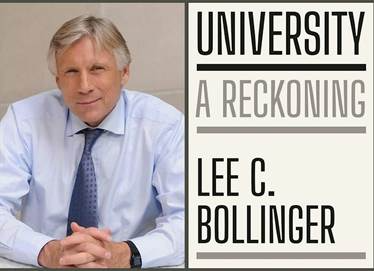
It was a book. Entitled University: A Reckoning, it is an intellectual tour de force – not just in terms of its description of the role universities play in the stability, health, and vitality of democracy, but also in its prescription for preserving their integrity and viability in times of authoritarian impulses.
I’ve been struck by the extent to we tend to fall back on arguments about the practical, measurable effects of higher education when we weigh the value proposition of the sector. Those arguments are deeply important and powerful. But they don’t really seem to pierce the intellectual or ideological predicate of the current administration’s assaults on institutions of higher education – which have taken particular aim at “elite” universities like Harvard, Penn, Columbia, Johns Hopkins, Princeton, Brown, Cornell, and Northwestern.
Lee chooses a different path of argument, constructing an elegant and utterly compelling case that universities are a foundation-stone of our nation’s democratic order. He argues that the university’s mission of preserving and enhancing knowledge is built on creative freedom . . . that creative freedom is inextricably interwoven with the primacy of first amendment principles . . . and that those principles stand at the heart of genuine and durable democracy.
To attack the ability of universities to preserve their academic freedom is accordingly to seek to drain the life-blood of entities that are the heart of American democracy.
Lee is uniquely qualified to make that argument. Not simply by virtue of having occupied the president’s chair at Michigan and Columbia, but also – and perhaps even more importantly – by being arguably the nation’s leading First Amendment scholar.
Lee proposes that universities be considered the fifth branch of our constitutional system, a standing accompanied by the full basket of protections a constitutional branch – whether executive, legislative, judicial, or press – must be afforded.
That means that universities must:
- Articulate unequivocally and continually for a new conception of their role in American society - one that erects new and inviolable barriers to the kind of attacks now being launched. As the title of his book about the free press suggests, a conception that ensures uninhibited, robust, and wide-open academic freedom rooted in First Amendment principles.
- Engage in collective action. Behave in a way commensurate with a branch’s constitutional standing. Although sympathetic to the temptation justifiably felt by individual universities to cut an appeasement deal with the administration, Lee argues that “a unified resistance” is the only real path;
- Pursue pathways to reducing dependence on federal funding. Too late for the moment, but never too late to plan for, and reorient toward, the longer-term.
We are beyond fortunate as a nation to have Lee’s courage, clarity of vision, and integrity.
Rip