The Birth of a Circulatory System: An Introduction to Detroit's Public Libraries
Good Friday afternoon, everyone:
One of the hazards of a summer break is the possibility that one will read something entirely unrelated to work, something a bit idiosyncratic, something that probably doesn ’t really contribute to a deeper diagnosis of contemporary challenges.
Well, I succumbed. My mother was a librarian – a librarian of children ’s books, to be exact. And I served for six years on the Minneapolis Library Board, the last two as chair.
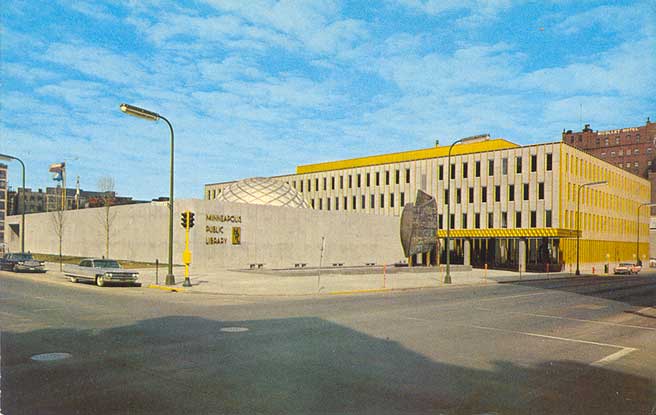
So when I went in search of an audiobook for my long drive to Northern Michigan, I was swept in by the unlikely titled The Library Book , written by Susan Orlean.
Before you judge me too harshly, let me add that the book chronicles the 1986 fire that devastated the Los Angeles Central Public Library, destroying 400,000 books and damaging another 700,000 – more than half the collection. It is also a who-dunnit, exploring the life of the likely arsonist.

It is a meandering, loving reflection on the roles that public libraries have played in the nation ’s history – and how that role has both changed and remained constant of the last 250 years. Which, in turn, led me to recall the joy – and some of the heartburn – I took from participating in the lives of Minneapolis ’ thirteen libraries (one central, twelve branches). And it reminded me of the special sense one has when stepping inside Memphis ’ Cossett Library, which we did when I recently interviewed Mayor Young.

And, perhaps most importantly, it caused me to reflect on how very little I know about the Detroit public library system. Libraries are like a city ’s circulation system, with books moving daily from one branch to another in response to resident requests for historical fiction, biographies, romance novels, self-help books, and whatever is current in favor on Oprah ’s book club.
So . . . . I wanted to try a few nightly notes on these extraordinary institutions and how they have factored into Detroit ’s civic life. Tonight, the briefest introduction to the Detroit Public Library System.
In the early 1800 ’s, well before Andrew Carnegie began directing his largesse to libraries, the Michigan state constitution provided that fines and penalties collected in criminal cases be devoted to establishing public libraries. At first, they were subscription libraries (i.e., for fee-paying members), starting in 1837 with the Detroit Reading Room and the Young Men's Society library at midcentury.
It wasn ’t until some thirty years later – in 1865 – when Detroit ’s population numbered less than 50,000 souls – that the Detroit Public Library opened. It occupied a single room on the second floor of the old state Capitol building in Capitol Park. But that modest room held some 5,000 volumes. Governed initially by the city ’s Board of Education, the collection was handed over in 1881 to a six-member Detroit Library Commission – essentially the structure we have today.
In the meantime, however, it had become apparent that the library needed an upgraded home. It was given one in 1877, at the intersection of Farmer and Gratiot.
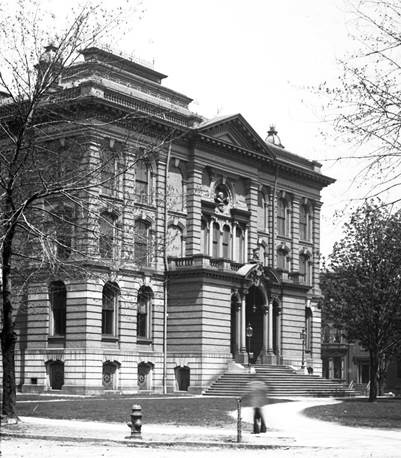
It was called the Center Park Library. It now housed some 33,000 volumes (for Detroit ’s now-rapidly-approaching-100,000 residents), which could be extracted by requesting books from librarians working behind ornamental screens – much like tellers at a bank.
That held – with a couple of additions – until 1910, when Andrew Carnegie enters the Detroit scene. We ’ll stop there for the moment.
Rip