PAC-MAN in the Cosmos: How Supermassive Black Holes Grow
Good evening, everyone:
I’m in Cleveland, talking with other place-based funders about the extraordinary work the Cleveland Foundation is doing in gaining site control over both residential and industrial properties to spur the region’s economic development. The audaciousness of their ambition makes it seem like an alternative universe.
Which reminds me that it has been light years since I last wrote about universes. That’s probably not a bad thing, but it did open up space for another entry. So . . . . . .
A recent scientific journal reported earlier this month that the miraculous James Webb telescope identified a “big red dot” from about four billion years into the universe’s life (i.e., after the Big Bang) that is a black hole. The Webb scientific interpreters dubbed it BiRD, for Big Red Dot. Nothing earth-shattering. At least not until the Webbites (who are, impressively, observers from the National Institute for Astrophysics) revealed that BiRD is actually an aggregation of a vast number of “red dots” with a combined size around 100 million times that of our galaxy’s sun.
The media platform Space.com suggested the following visualization on the left, based on the actual image on the right:
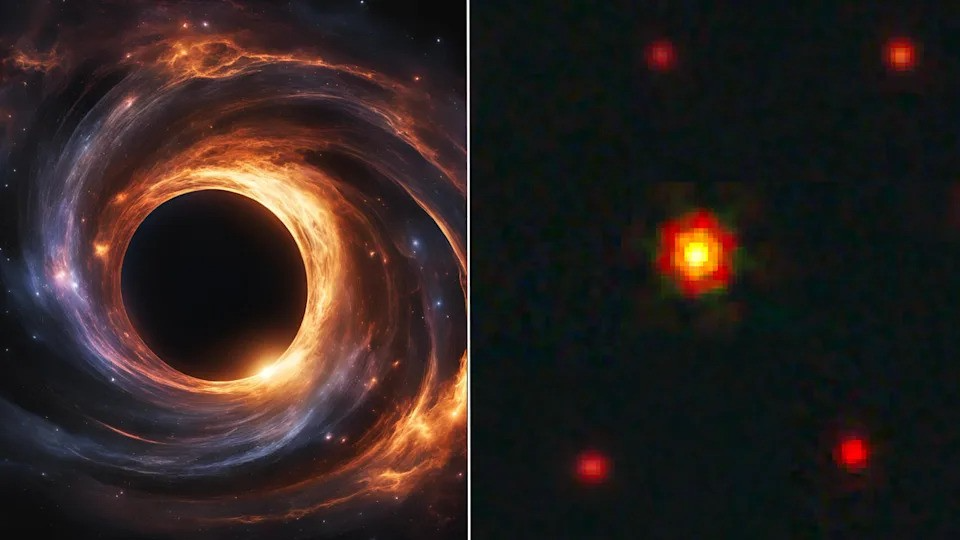
Given that black holes suck in light (and everything else for that matter) because of their incomprehensibly large gravitational pull, one might reasonably ask why red objects (i.e., something defined as light) in the sky could possibly be black holes. Our friends at Science.com explain: When a black hole is surrounded by matter they are “feeding” on:
The material and jets blasted out from the poles of the black holes create a very conspicuous and bright object called a quasar. These can be seen from vast distances; for example, the light from BiRD has been travelling to Earth for 10 billion years.
Evidently astronomers have been keeping an eye on this part of the sky for a while. But it was only very recently that, with the capacities of the Webb telescope to detect infrared light, they detected BiRD.
One of the astronomers clarified things: "We found clear signals of [a hydrogen] called Paschen gamma, a luminous signature that reveals the presence of ionized hydrogen — and helium, also visible in absorption." Pretty much what I thought.
I’m intrigued by the idea that we now appear to know a bit more about how supermassive black holes grow. Kind of like PAC-MAN – eating up little dots as it goes about its business:


Art imitating life.
Rip