Dark Matter, WIMPs, and Other Reasons for Wonder
Good evening, everyone:
After such a deflating last week of news – and nightly notes – I wanted to steer in a different direction. And because it ’s difficult to imagine a philanthropy committed to improving equity and opportunity in American cities without diving deeply into cosmological theory, I thought I ’d offer the following.
Because . . . . . . . for the very first time since I began writing these notes in March of 2020 (or, more accurately, for the first time in approximately 12 billion years), there is some reason to believe that astronomers have “seen ” dark matter – that un-seeable stuff that appears to make up 85 percent of the universe . . . that doesn ’t absorb or emit light . . . and that exerts some form of gravitational pull on the galaxies found within it.
Indeed, because dark matter is invisible and unmeasurable, some scientists have concluded that it may not even be there (although if it isn ’t, it ’s not clear what is).
And yet, there is now a claim that a lucky few have “seen ” it. Before explaining whether/why/how/where/when, let me back up a century.
An astronomer named astronomer Fritz Zwicky (below) theorized the existence of dark matter almost 100 years ago.

It took 80 years for another astronomer – named Vera Rubin – to provide a semblance of “proof ” of dark matter by noting that a team had discovered spiral galaxies in which – according to the journalist Robert Lee in Space.com – “the outer edges were spinning at the same rate as their centers, something that would only be possible if the major amount of mass in these galaxies wasn't concentrated at their centers [in stars and other observable objects], but rather more widely dispersed [in forms of energy that is not visible]. ”
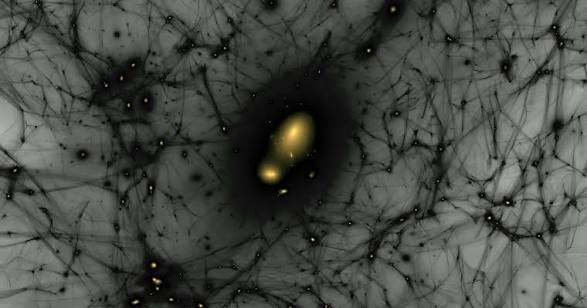
Up until now, scientists explained this by theorizing that large galaxies sit within huge “haloes ” of dark matter that reach beyond the borders of visible matter.
Here ’s one artist ’s version – offered with the understanding that it ’s difficult to resist seeing the handiwork of a cosmic spider beyond the dark matter:
Astronomers could theorize the existence of these haloes, but they still couldn ’t “see ” them. Enter a device called the Fermi gamma-ray space telescope, a piece of equipment owned by NASA (although I ’m not sure if NASA still exists – I ’m vaguely recalling it may have been collateral damage during the Elon Musk ’s Reduction in Force initiative).
Here ’s journalist Lee ’s explanation of how the Fermi device helped:
If dark matter particles ‘annihilate ’ when they meet each other and interact, much as matter and its counterpart antimatter do, then it should produce a shower of particles, including photons of gamma-rays, that could be ‘seen ’ by sensitive gamma-ray space telescopes.
One of those "self-annihilating " particles is the so-called "Weakly Interacting Massive Particles " or "WIMPS. "
Hard to take that last sentence seriously – don ’t you want to know who was involved in the naming convention (hint, it was not Secretary Hegseth, although, on second thought, maybe it was)?
And sure enough, the Fermi gamma ray telescope did detect WIMPS . Here ’s the image that explains it:
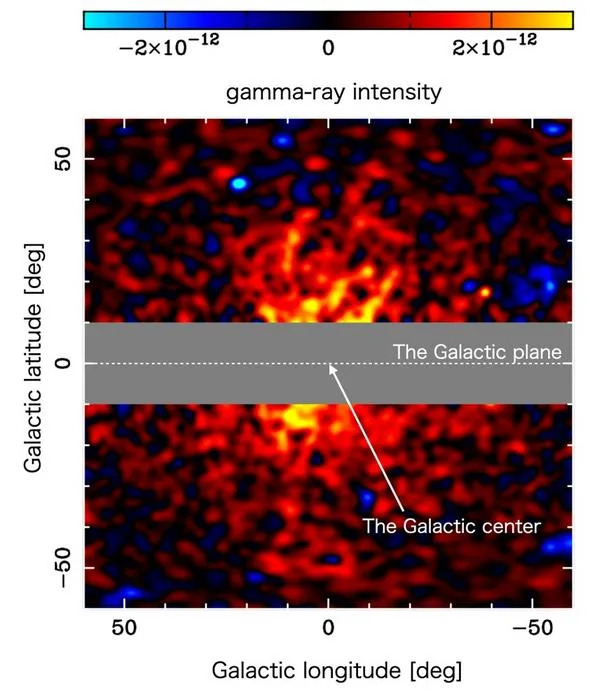
Although this image – produced by Tomonori Totani at the University of Tokyo – requires no explanation (we are certainly all familiar with a “y Galactic-latitude axis and an x Galactic longitude axis ”), let me provide one anyway.
Totani went on a search for the gamma rays that might be the halo to a galaxy ’s center. Sure enough, turns out that when you aim a superpowered telescope long enough, you find it. In Totani ’s words: “[We found] Gamma rays with a photon energy of 20 giga-electronvolts extending in a halo-like structure toward the center of the Milky Way galaxy. The energy signature of these gamma-rays closely matches those predicted to emerge from the annihilation of colliding WIMPs. ”
Case closed.
Some might quibble that more proof is needed. Balderdash. We know “Gamma rays with a photon energy of 20 giga-electronvolts extending in a halo-like structure ” when we see them. And we ’ve seen them, evidently.
Rip