A Colleague's Reflections on "Drawn to Challenge"
Good evening, everyone. Your favorite CFO here: Amy Robinson .
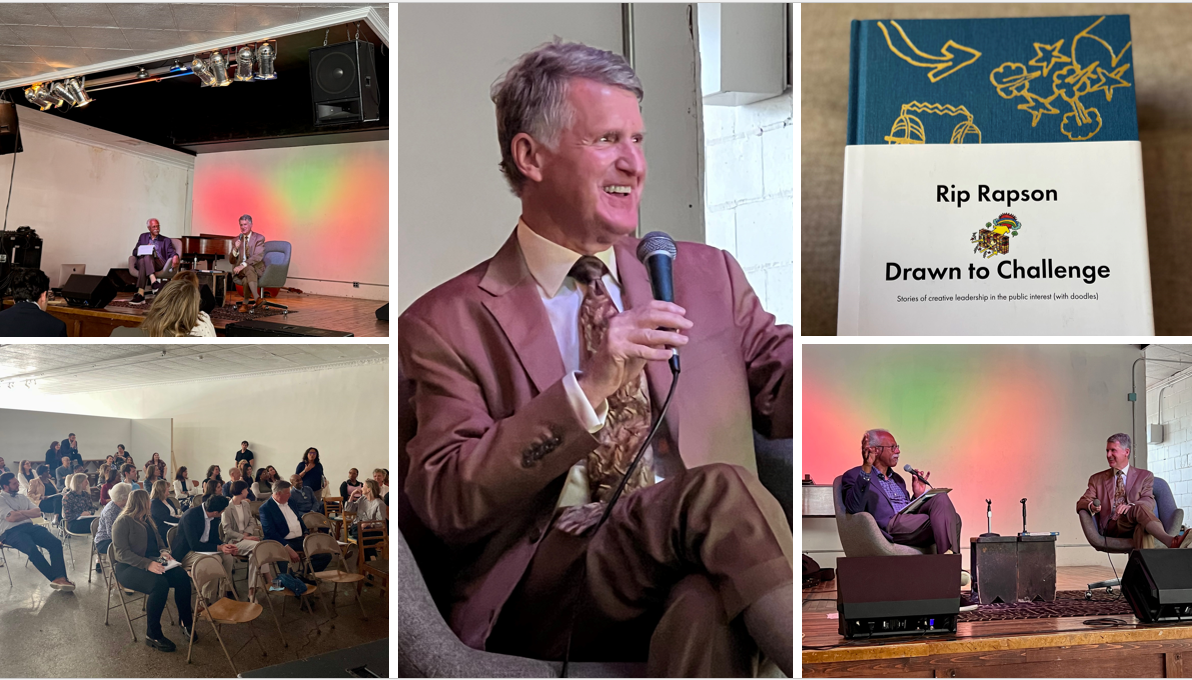
Occasionally, Rip allows me to take over his nightly note and today is one of those occasions. I ’m so excited to share a recap of an event that John Barker, Benjy Kennedy and I hosted last night in honor of the debut of Rip ’s new book, “Drawn to Challenge: Stories of Creative Leadership in the Public Interest (with Doodles). ”
More than 70 current and former staff joined us at Trinospheres, a multi-use arts venue and café in the historic Eastern Market District of Detroit, where we were treated to a fireside chat between Rip and our recently retired colleague, W. Kim Heron. Rip also presented an autographed copy of the book to every staff member.
"Drawn to Challenge " represents the culmination of Rip ’s decades of experience at the intersection of philanthropy, urban policy, and social change. The book – which as its subtitle promises – includes one of Rip ’s signature “doodles ” in every chapter. The stories span Rip ’s life and include important leadership lessons that he draws from each situation. Further, it gives us a glimpse into the experiences that shape how he shows up every single day in our organization – as a creative and caring leader.
Rip and Kim spoke about several of those situations that were sometimes intentional, like the time he went around a city official to begin a city-wide arts & culture program in Minneapolis. And sometimes they were unintentional, like the time he found himself mediating the surrender of a suspected murderer. (This all makes philanthropy look like a walk in the park, doesn ’t it?)
What strikes me most about Rip ’s stories is his remarkable memory. He recalls names, personal characteristics, and the current events of the day with such detail in each of the 24 chapters that it is easy to forget that some of the tales took place more than 50 years ago. The earliest story he shares is as a young boy visiting a library at the University of Minnesota where his mother volunteered cataloguing children ’s books. (And yes, he admits that experience – coupled with watching his architect father endlessly sketch – may have seeded his later desire to “doodle. ”)
Rip ’s impulse to write the book was for his family, who he says, “have no idea what I do all day! ” But as he refined the stories, Rip came to understand that they might be useful to the next generation of leaders. After reading the book, I couldn ’t agree more.
Rip and Kim ’s conversation guided the crowd through some of the book ’s highlights, but there were a few nuggets about Rip and lessons from the book that I ’d like to share for those who missed it:
- Despite reliable rumors, Rip was NOT born wearing a necktie last night.
2. .Enter every conversation by listening first, and “be the 7 th person to speak ”– not the first – in a roundtable conversation.
- Titles can be intimidating, especially those who go by “Vice Lord, ” but usually the person is softer than the reputation.
- Don ’t doubt yourself if you ’ve considered writing a memoir of your own: you probably have something to offer.
- It ’s easy to lose sight of your immediate community when there is such disruption at the national level. But problems take root locally, so focus there where you can make a difference.
Thank you Rip, for writing this book and providing your family, the staff, and the world with a better understanding of your career and what drives you. I ’m also grateful to you for reinforcing the important lesson that lasting change doesn ’t come through heroic individual leadership, but through the patient building of relationships … with neighbors and constituents … and even Vice Lords. As you always do, you make us laugh and prompt us to think more deeply about the roles. We are so very fortunate to have you lead this organization and our important work serving others.
All the best, Amy